


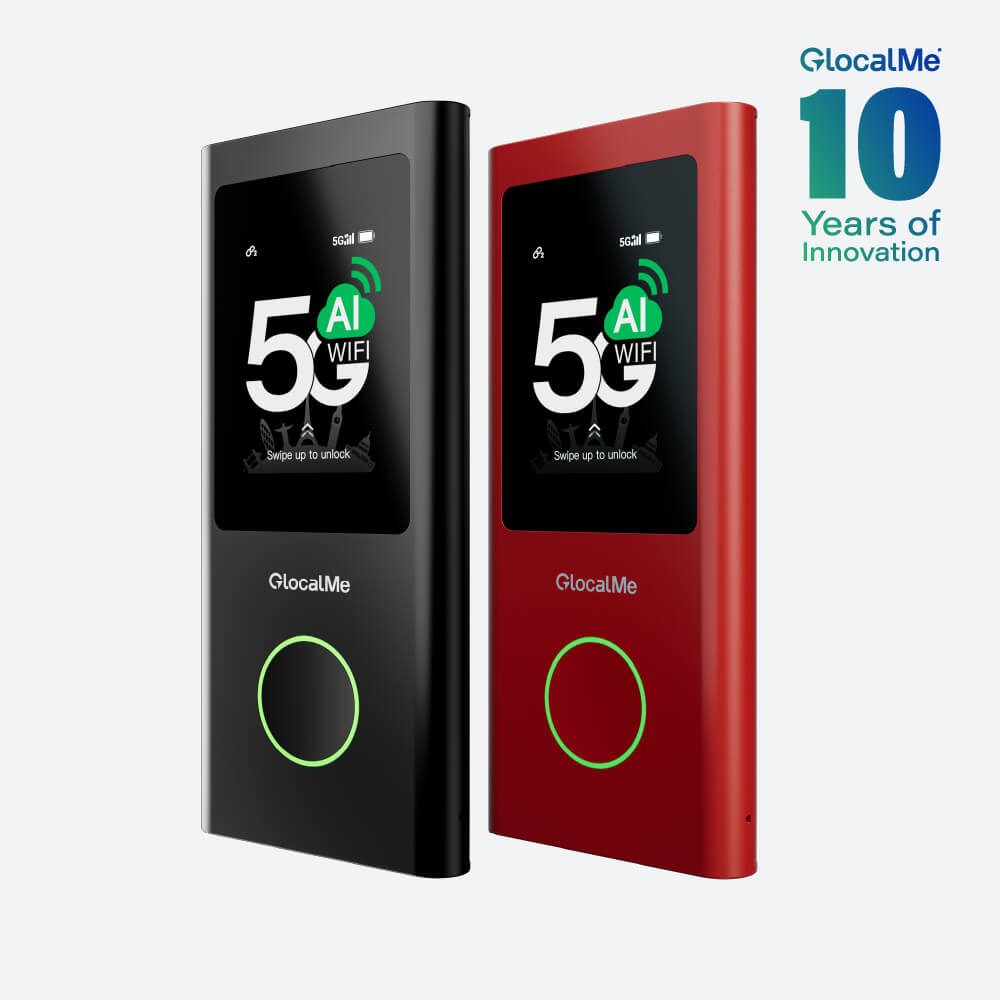


A portable WiFi hotspot device can provide internet access when several devices need to stay connected while traveling. However, choosing between 5G and 4G LTE depends on more than just network speed.
Device count, travel style, battery requirements, coverage, and online activities all affect the right choice. A 5G hotspot can be useful for remote work and high data usage, while 4G LTE can be sufficient for everyday travel.
GlocalMe offers both options, including the GlocalMe Numen Air 5G Mobile Wi-Fi hotspot and the GlocalMe U3 Portable WiFi 4G LTE Hotspot for travel.

5G vs 4G LTE for Travel WiFi
5G can provide higher speeds and lower latency when suitable 5G coverage is available. This can benefit video meetings, cloud applications, large file transfers, and multiple devices using the connection at the same time.
4G LTE remains suitable for many common travel activities. Navigation, messaging, email, web browsing, social media, and standard video streaming generally do not require the highest available network speeds.
| Factor | 5G Portable WiFi | 4G LTE Portable WiFi |
| Basic travel use | More than sufficient | Well suited |
| Video meetings | Strong option | Suitable with good coverage |
| Large file transfers | Faster where 5G is available | More time may be required |
| Multiple devices | Strong option | Suitable for moderate use |
| Portability | Depends on device | Often lightweight |
The better choice depends on how the connection will actually be used.
When Is a 5G Portable WiFi Hotspot Device Worth Choosing?
A 5G hotspot becomes more valuable when internet performance directly affects the trip. Several situations can make the additional capacity particularly useful.
Remote Work and Business Travel
Remote work often involves more than checking email. Video meetings, cloud applications, large file transfers, and collaborative platforms can place greater demands on a travel connection.
For business travelers who regularly work from hotels, coworking spaces, airports, or other temporary locations, a 5G portable WiFi hotspot device can provide more performance headroom when strong 5G coverage is available.
Multiple Devices and Heavy Data Use
Several connected devices can increase overall network demand. Travelers may use a laptop for work while phones and tablets handle communication or entertainment. 5G can provide greater performance for these situations, particularly when several devices are actively using data rather than simply remaining connected.
Strong 5G Coverage
The benefits of 5G depend on the destination. A 5G device does not guarantee a 5G connection everywhere, since actual performance depends on local coverage, network congestion, and infrastructure. For destinations with strong 5G availability, however, choosing a 5G hotspot can provide additional speed and capacity for demanding use.
When Is a 4G LTE Portable WiFi Hotspot Enough?
Not every trip requires the additional performance of 5G. For many travelers, 4G LTE provides enough connectivity for the activities they use most often.
Everyday Travel Connectivity
Navigation, messaging, email, web browsing, social media, and music streaming generally work well with a stable 4G LTE connection. Travelers who mainly need internet access for these everyday activities may find 4G LTE sufficient. It can also be a practical choice for travelers who prefer a straightforward setup without prioritizing maximum network speed.
Leisure Trips With Moderate Data Use
Vacation connectivity is often less demanding than business connectivity. Checking attractions, uploading photos, watching occasional videos, communicating with family, and browsing travel information typically do not require the highest available bandwidth. For these trips, a 4G portable WiFi hotspot device can provide the necessary connection while keeping the device compact and easy to carry.
Lightweight Travel
Weight and size matter when you carry a hotspot all day while sightseeing. A smaller device can fit more easily into a pocket, purse, or small travel bag. This makes 4G LTE particularly appealing to travelers who prioritize portability alongside reliable everyday connectivity.
Choosing 5G or 4G LTE for Different Travel Scenarios
The best option also depends on the way the connection will be used during the trip. Looking at common travel scenarios can make the differences between 5G and 4G LTE easier to understand.
Solo City Travel
For a solo traveler who mainly uses a smartphone and occasionally connects another device, 4G LTE may provide enough performance. A 5G hotspot becomes more attractive when the trip includes frequent video calls, laptop work, or heavier data use.
Family Holidays
Family trips often involve several smartphones, tablets, and other devices connecting at the same time. A 5G hotspot can provide more capacity for shared use, especially when several people stream or browse simultaneously.
For lighter family usage, however, a 4G LTE hotspot may still provide sufficient connectivity.
Business Trips
Business travel generally places greater demands on internet access. Video conferencing, cloud-based work, file transfers, and remote access can benefit from the higher performance available through 5G. When reliable 5G coverage is available at the destination, a 5G portable WiFi hotspot device can therefore be a stronger fit for work-focused travel.
Road Trips and Multi-Destination Travel
Road trips can involve changing network conditions as the route moves between cities and regions. In these situations, broad 4G availability remains important, while 5G can provide additional performance in areas where compatible coverage is available.
What to Consider Before Buying a Portable WiFi Hotspot Device
Network generation is only one part of the decision. A practical comparison should also consider how the hotspot fits into the travel routine.
Coverage
Check whether the device and selected service support the destinations on the itinerary. Broad carrier access can be particularly important for international and multi-country travel.
Connected Devices
Think about the number of devices that will regularly share the connection. Solo travelers may only need one or two connections, while families and remote workers may have several devices online at once.
Battery Life
A hotspot can be particularly useful during long periods away from a power outlet. Battery capacity and expected usage time are worth comparing, especially for full days of travel or long journeys between destinations.
Size and Weight
Portability matters when the device is carried throughout the day. A lighter hotspot can be preferable for sightseeing and minimalist travel, while travelers with higher connectivity requirements may prioritize capacity over the smallest possible form factor.
GlocalMe 5G and 4G LTE Portable WiFi Hotspot Devices
GlocalMe offers both 5G and 4G LTE options for different travel needs. Looking at the two devices individually first makes it easier to understand how their specifications translate into real travel scenarios.
GlocalMe Numen Air for High-Demand Travel

The GlocalMe Numen Air 5G Mobile Wi-Fi hotspot supports 5G in more than 90 countries and 4G in more than 200 countries across more than 390 carrier networks.
It supports up to 16 connected devices and has a 5,400mAh battery, providing up to 11 hours of 5G network usage and up to 15 hours on 4G under specified conditions.
The device is suited to business travel, remote work, family trips, and other situations involving several devices or higher data demands.
GlocalMe U3 for Lightweight 4G LTE Travel

The GlocalMe U3 Portable WiFi 4G LTE Hotspot for travel provides access to more than 390 carrier networks across more than 200 countries.
It supports up to 10 connected devices and provides up to 12 hours of use with a 3,000mAh battery. At approximately 125g and 1cm thick, its compact design makes it suitable for travelers who prioritize portability.
The U3 is well suited to everyday travel activities such as navigation, browsing, social media, communication, and moderate entertainment.
With both devices considered, the main differences become clearer when their specifications are placed side by side.
| Feature | GlocalMe Numen Air 5G | GlocalMe U3 4G LTE |
| Network | 5G and 4G | 4G LTE |
| Connected devices | Up to 16 | Up to 10 |
| Battery | 5,400mAh | 3,000mAh |
| Battery life | Up to 11 hours on 5G, up to 15 hours on 4G | Up to 12 hours |
| Weight | 194g | 125g |
| 5G coverage | 90+ countries | Not applicable |
| 4G coverage | 200+ countries | 200+ countries |
| Best suited to | High-demand travel and multiple devices | Lightweight travel and everyday connectivity |
The comparison shows that the choice is not simply between a more advanced and a less advanced device. The Numen Air prioritizes network performance and capacity, while the U3 puts greater emphasis on portability and straightforward 4G LTE connectivity.
Choosing the Right Travel WiFi for Your Trip
The GlocalMe Numen Air 5G Mobile Wi-Fi hotspot is the stronger option for travelers who work from a laptop, connect several devices, handle larger files, or have higher data demands.
The GlocalMe U3 Portable WiFi 4G LTE Hotspot for travel is better suited to travelers who prioritize a lightweight device and mainly need internet for everyday travel activities.
Rather than choosing based only on the network generation, consider where the hotspot will be used and what it will be expected to handle. This makes it easier to select a portable WiFi hotspot device that fits the trip without paying for performance that may not be necessary.


